Description
- No maida
- Jaggery, not sugar
- Desi ghee
- No palm oil
- No preservatives
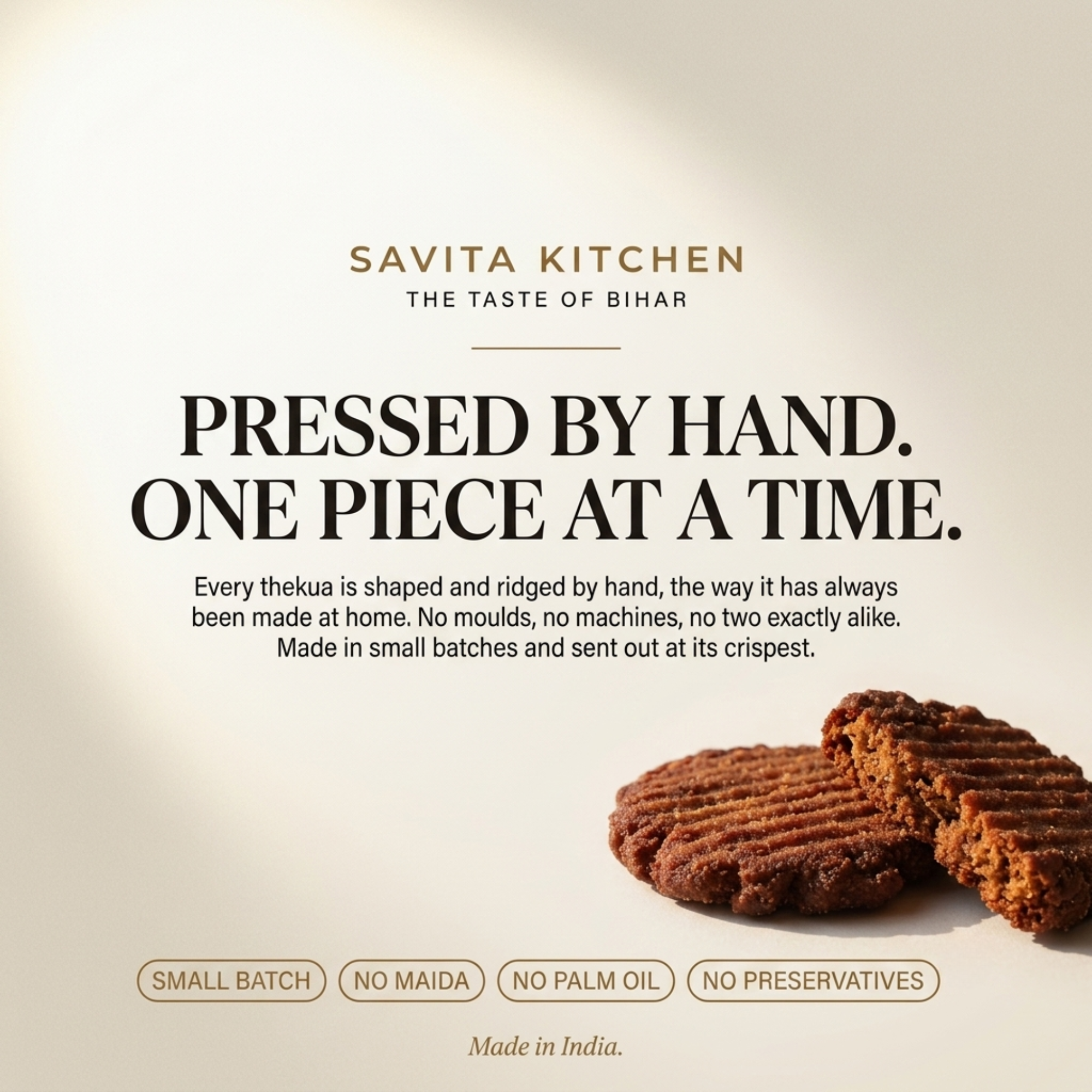
- Pressed by hand
The taste of Bihar
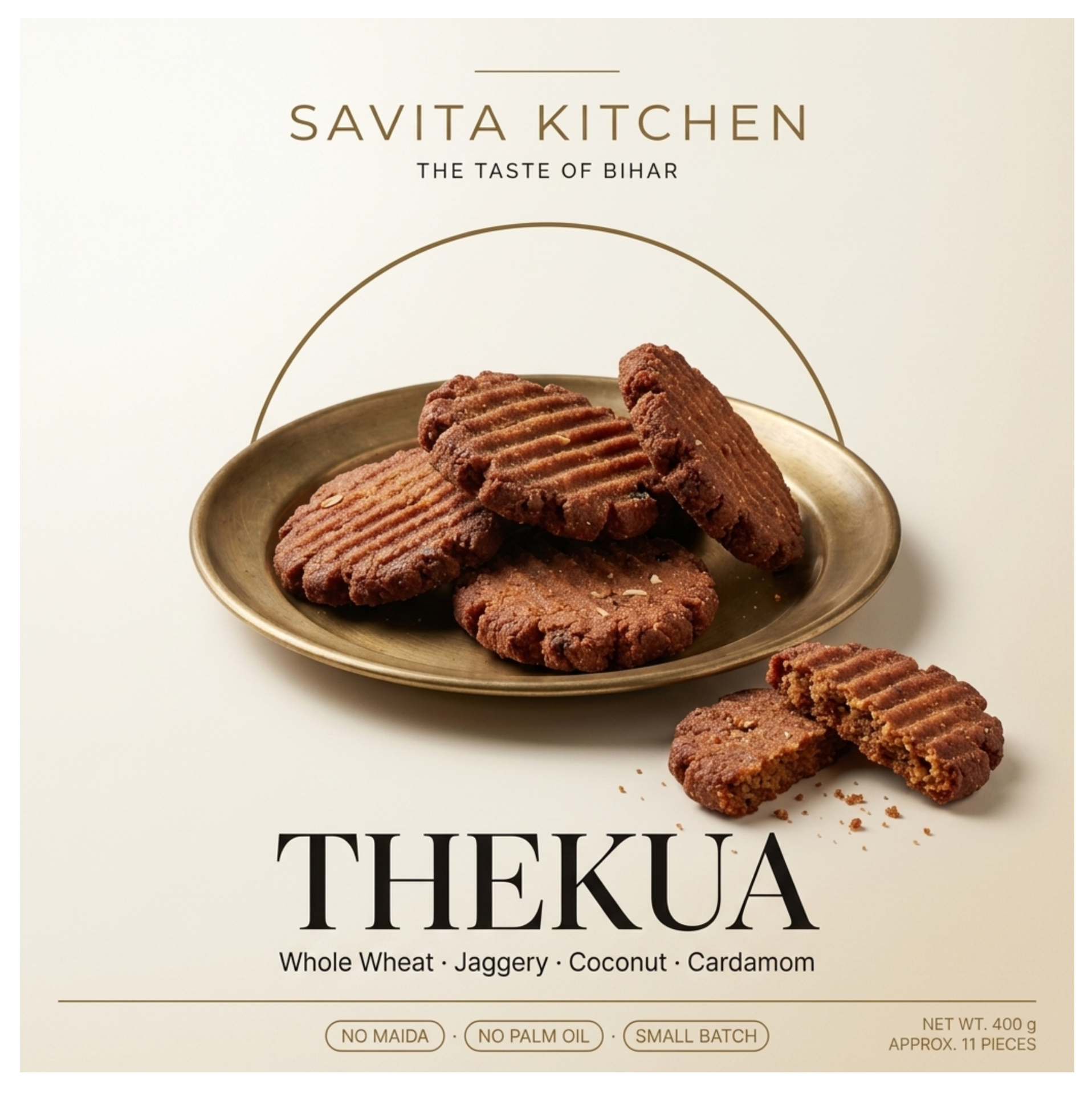
Thekua, the way Bihar has always made it
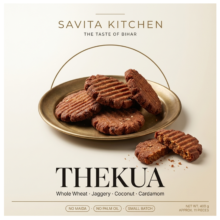
For four days every November, kitchens across Bihar and eastern Uttar Pradesh smell of jaggery and cardamom. Thekua is what those kitchens are making — whole wheat atta kneaded stiff with gur, pressed by hand into ridged discs, and fried until the edges go dark and the middle stays short and crumbly. It is the taste people carry with them when they leave home.
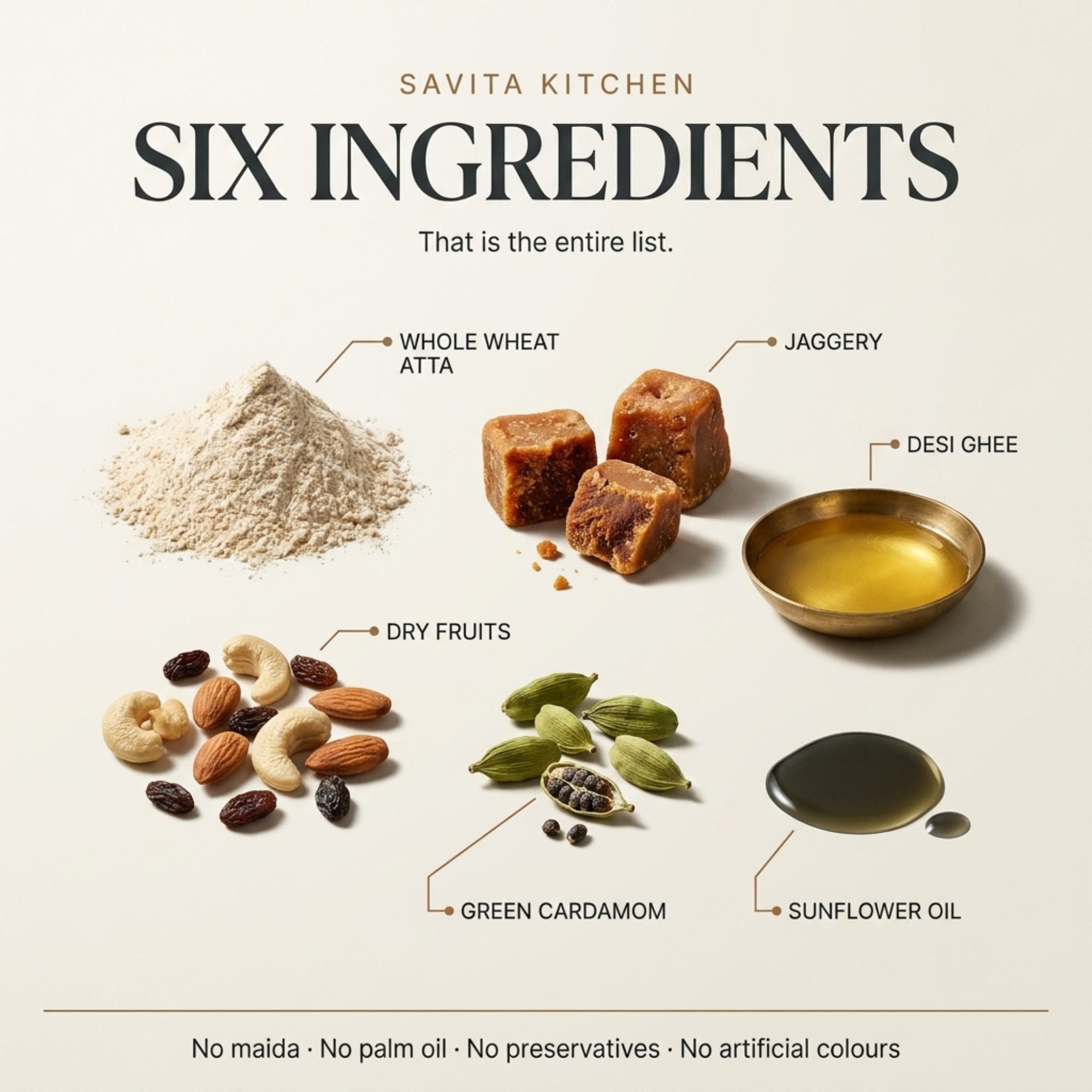
Savita Kitchen’s thekua is Savita Devi’s own recipe, unchanged in thirty years: whole wheat flour, jaggery, desi ghee, sunflower oil, cashew, almond, raisin and green cardamom. Six ingredients. No maida, no refined sugar, no palm oil, no dalda, no preservatives.
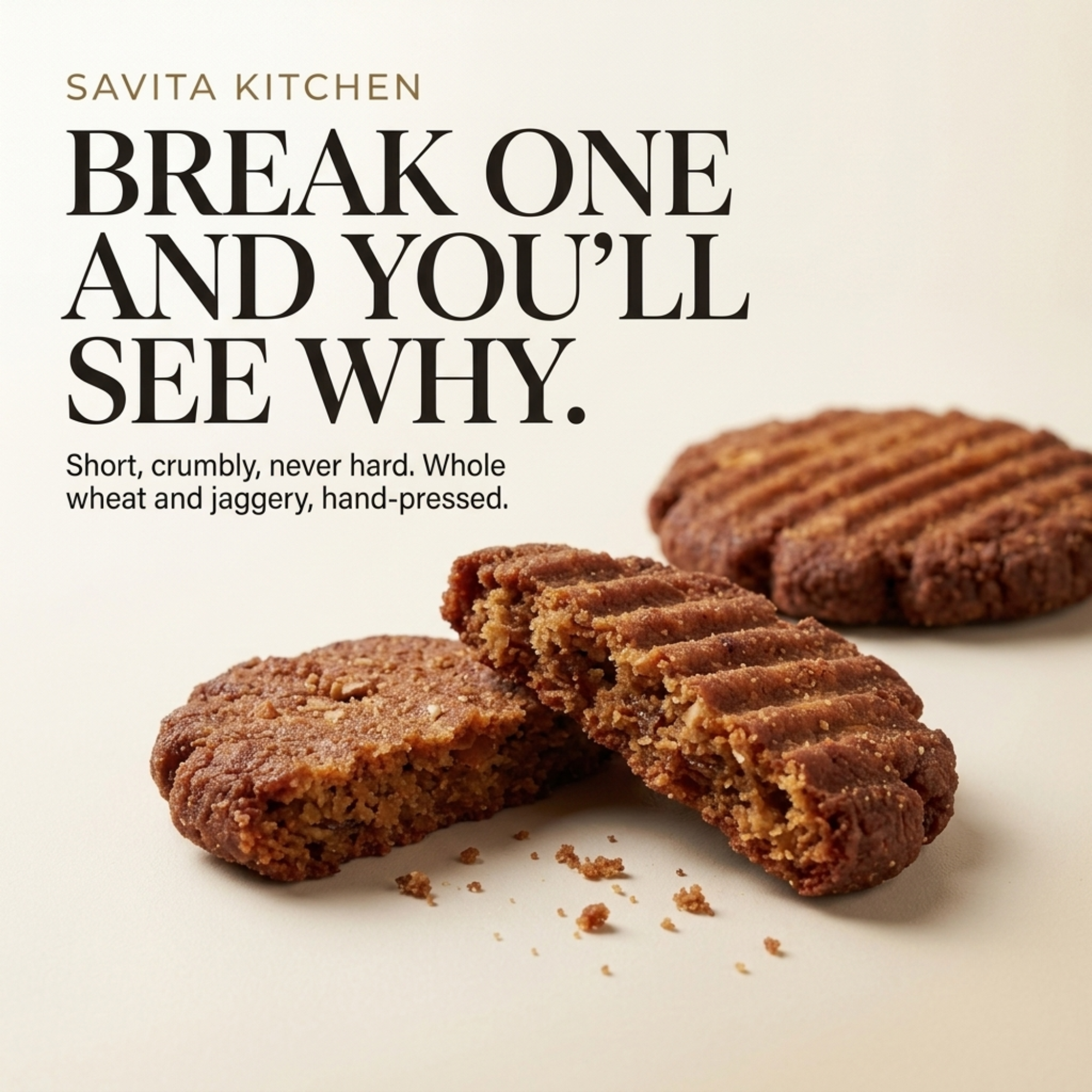
Every piece is shaped and ridged by hand — no moulds, no machines — so no two are exactly alike. Made in small batches, sealed the same week, and sent out at its crispest.
Why our thekua tastes different
Whole wheat and gur, not maida and sugar
Most packaged thekua is cut with maida and sweetened with refined sugar, because both are cheaper and easier to work with. Ours is 48% whole wheat atta and 24% jaggery, and that is what gives it a deep, molasses-dark sweetness instead of a flat one.
Desi ghee in the dough
Ghee is the moyan — the shortening that makes thekua crumble rather than crack a tooth. We use real desi ghee, not vanaspati or palm shortening, and you can smell the difference the moment the pack opens.
Pressed by hand, one at a time
Each piece is shaped and ridged by hand, the way it is done at home. Slower, less uniform, and the only way to get an edge that is properly crisp while the centre stays short.
Six ingredients. That is the entire list.
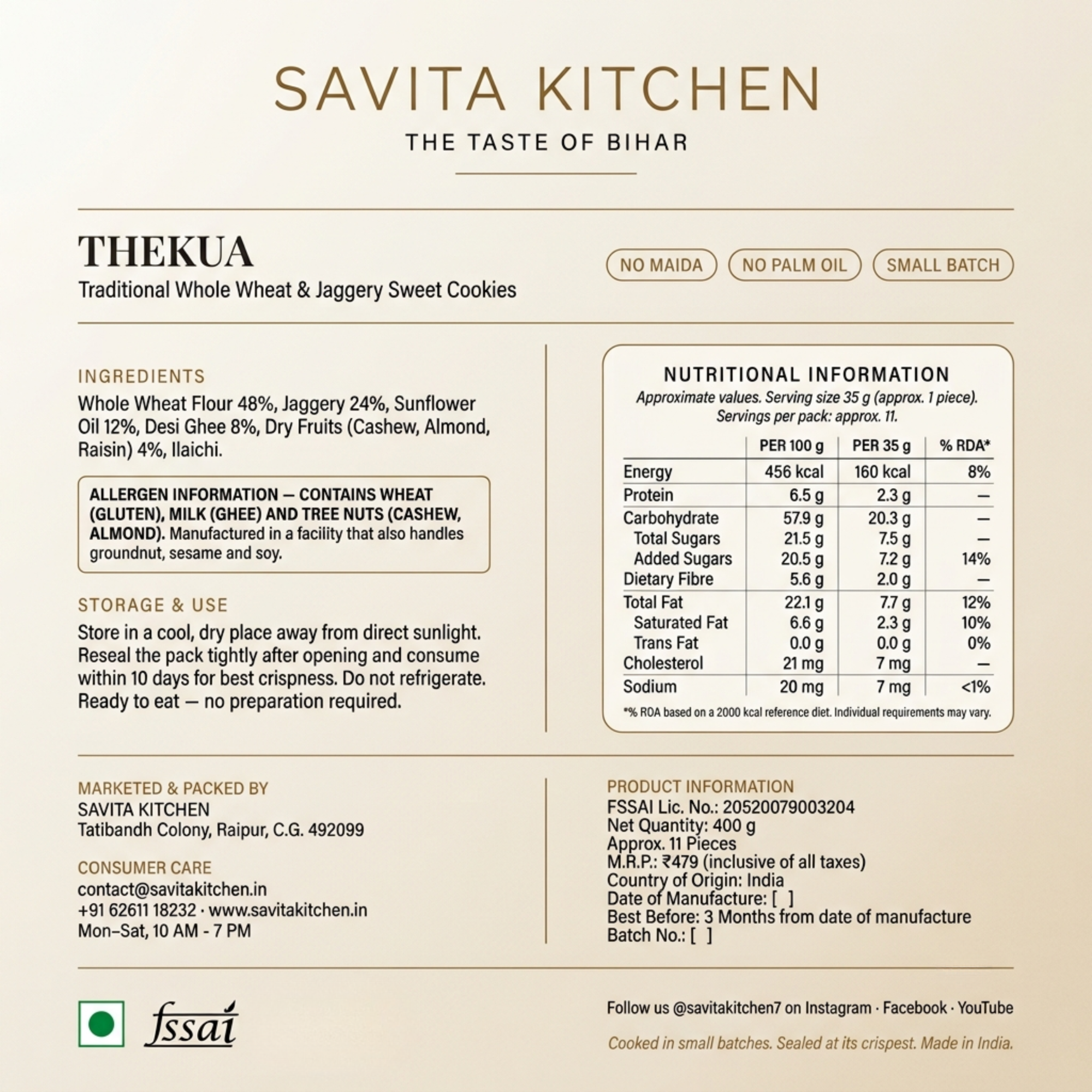
- Whole Wheat Flour 48%
- Jaggery 24%
- Sunflower Oil 12%
- Desi Ghee 8%
- Cashew, Almond & Raisin 4%
- Green Cardamom
Allergen information — Contains wheat (gluten), milk (ghee) and tree nuts (cashew, almond). Made in a kitchen that also handles groundnut, sesame and soy. Vegetarian, but not vegan.
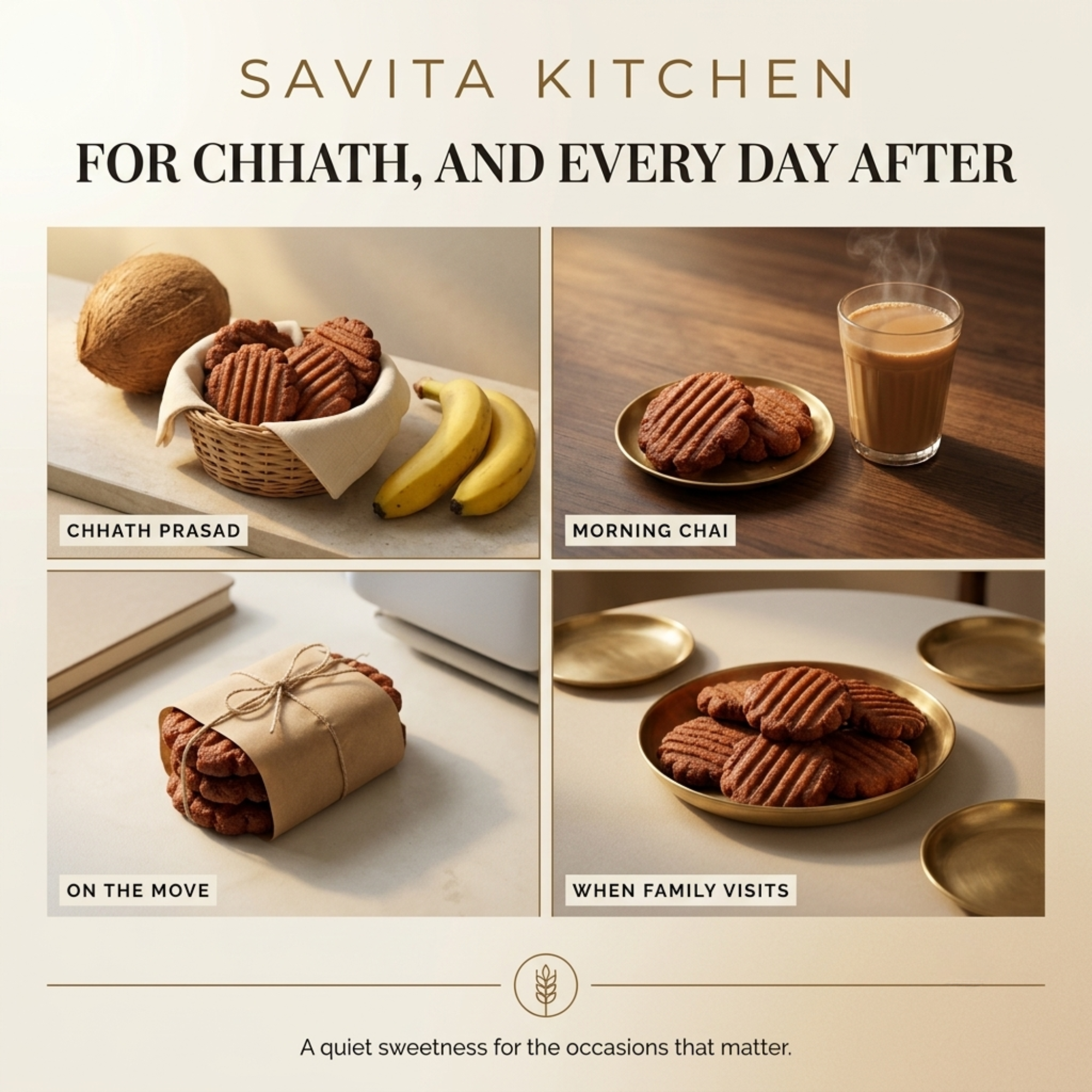
Thekua for Chhath, and every day after
Chhath Puja falls on 15 November in 2026, with the four days running from the 13th to the 16th. Thekua is the sweet most closely bound up with it, and for families living far from Bihar it is often the hardest thing to arrange. We make it through the season in small batches so it reaches you fresh, rather than sitting in a warehouse since September.
Around Chhath
The taste of the festival, for the family table and for guests through those four days.
Morning chai
One piece with the first cup. This is how thekua is actually eaten the rest of the year.
On the move
Travels well, does not melt, does not need a plate. Made for train journeys and desk drawers.
When family visits
Something homemade to put out that nobody has to be polite about.
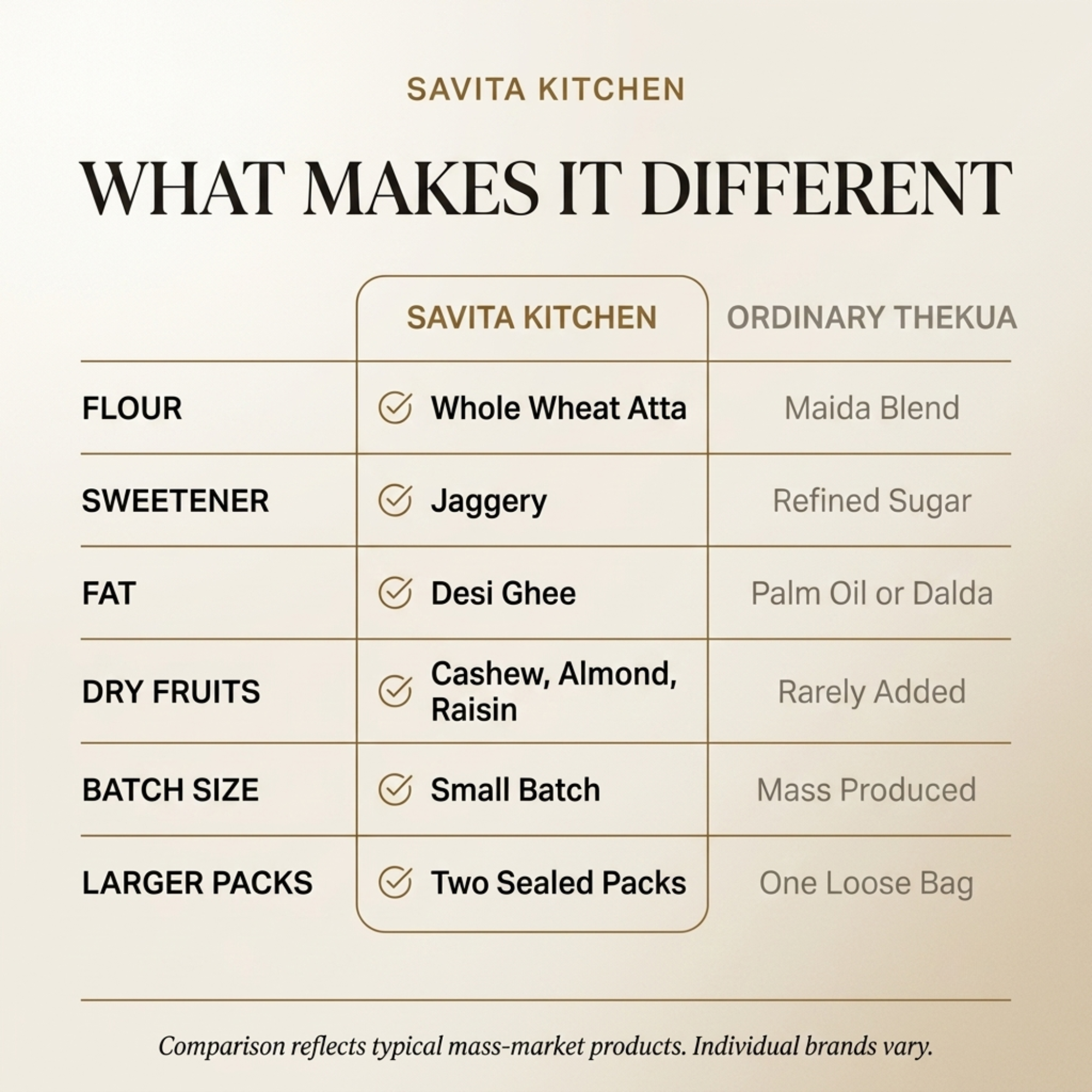
Savita Kitchen vs ordinary thekua
| Savita Kitchen | Ordinary thekua | |
|---|---|---|
| Flour | Whole wheat atta | Maida blend |
| Sweetener | Jaggery | Refined sugar |
| Fat | Desi ghee | Palm oil or dalda |
| Dry fruits | Cashew, almond, raisin | Rarely added |
| Batch size | Small batch | Mass produced |
| Larger packs | Two sealed packs | One loose bag |
Comparison reflects typical mass-market packaged thekua. Individual brands vary.
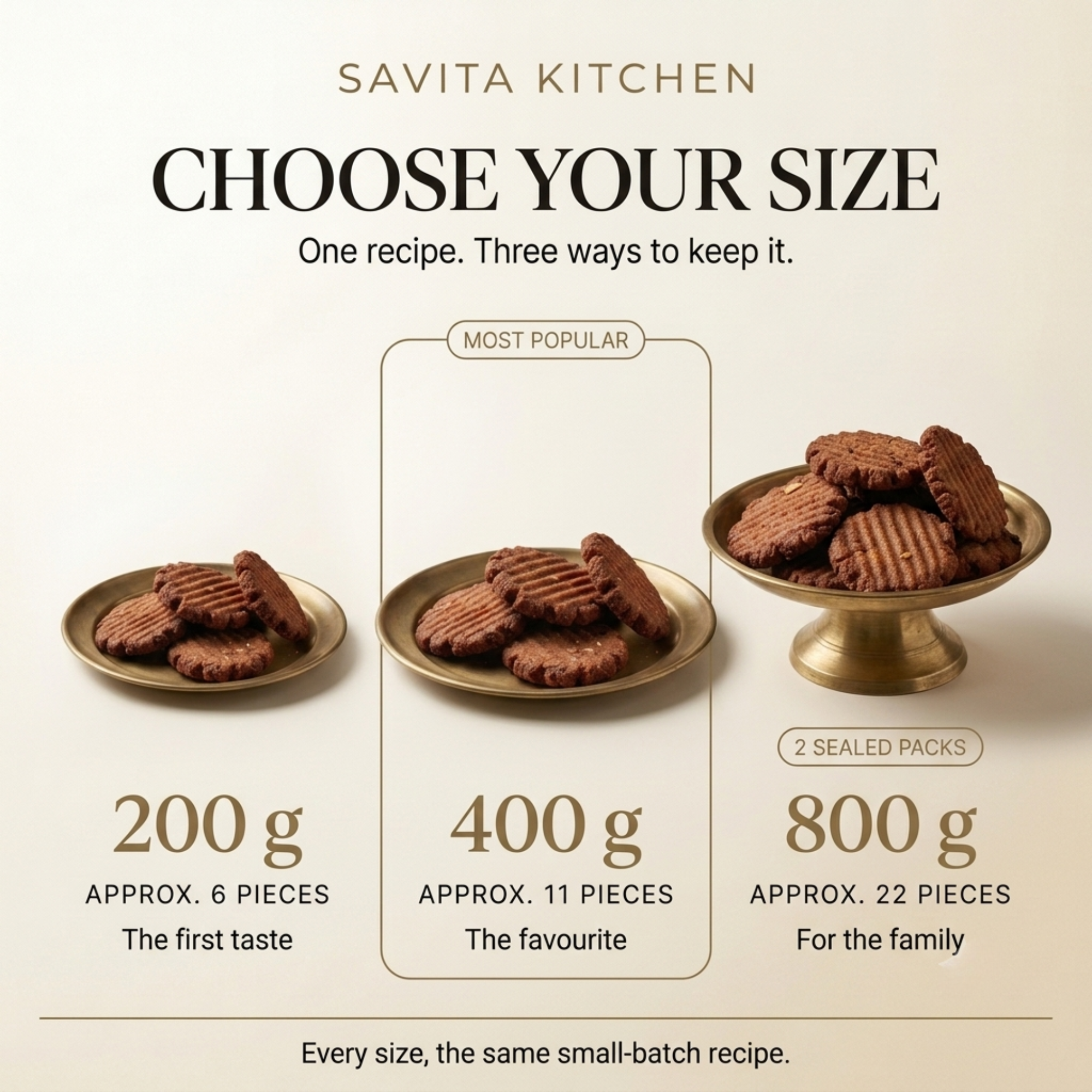
Choose your size
One recipe, three ways to keep it. Every size comes from the same small batch.
The first taste
For one person, or to try the recipe before you commit to a festival order.
The favourite
Our most ordered size. Enough for a household through a week, and the best balance of price and quantity.
For the family
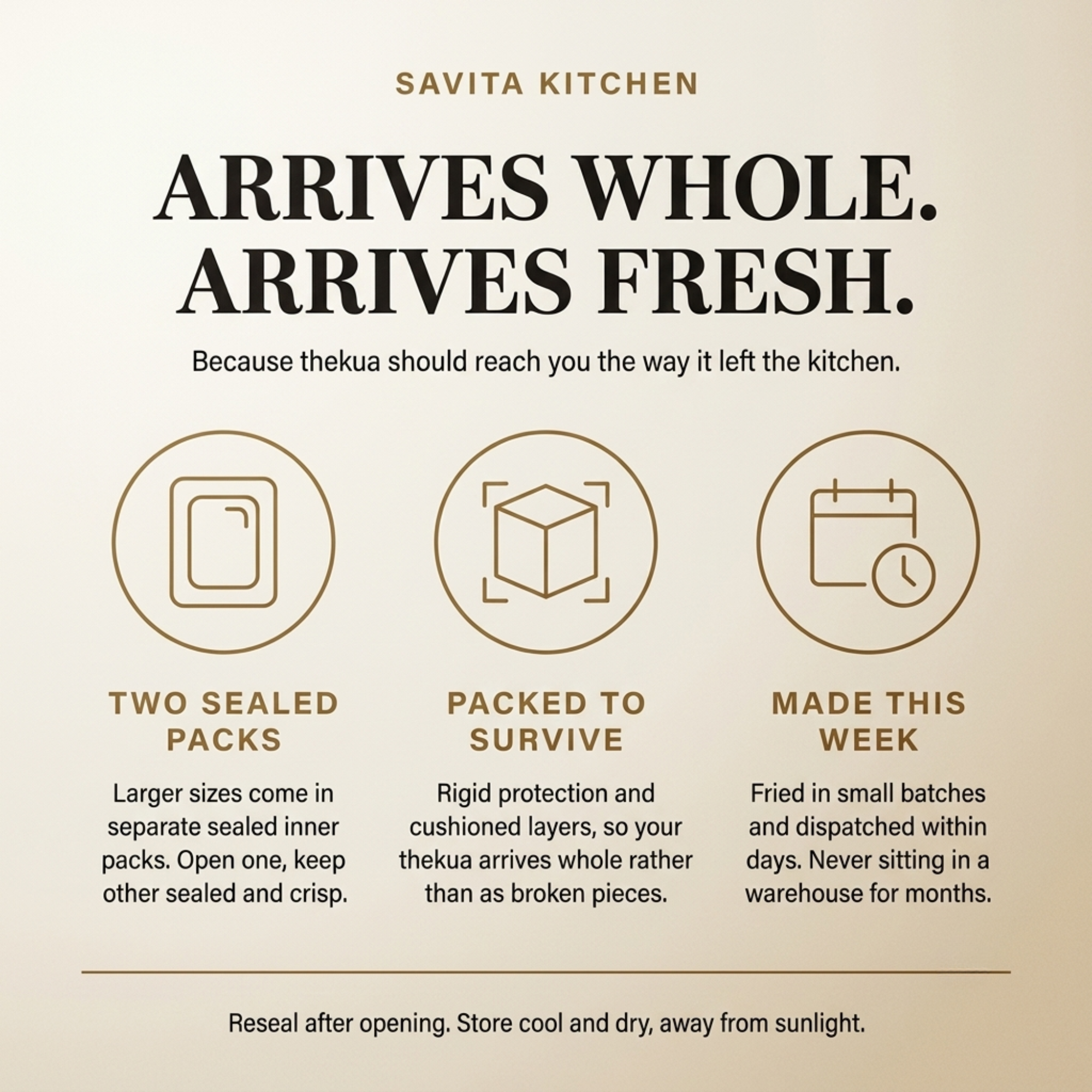
Supplied as two separately sealed inner packs. Open one, keep the other sealed and crisp — the right size for Chhath, for gifting, and for a joint family.
Nutrition information
Approximate values. Serving size 35 g, which is roughly one piece.
| Nutrient | Per 100 g | Per 35 g |
|---|---|---|
| Energy | 456 kcal | 160 kcal |
| Protein | 6.5 g | 2.3 g |
| Carbohydrate | 57.9 g | 20.3 g |
| Total sugars | 21.5 g | 7.5 g |
| Added sugars | 20.5 g | 7.2 g |
| Dietary fibre | 5.6 g | 2.0 g |
| Total fat | 22.1 g | 7.7 g |
| Saturated fat | 6.6 g | 2.3 g |
| Trans fat | 0.0 g | 0.0 g |
| Cholesterol | 21 mg | 7 mg |
| Sodium | 20 mg | 7 mg |
Storage & shelf life
Ready to eat — no preparation needed. Store in a cool, dry place away from direct sunlight. Reseal the pack tightly after opening and finish within 10 days for best crispness. Do not refrigerate; the moisture softens it. Best before 3 months from the date of manufacture, printed on the pack. The 800 g arrives as two sealed inner packs, so you only ever open what you are about to eat.
Product details
| Product name | Thekua — Traditional Whole Wheat & Jaggery Sweet Cookies |
| Net quantity | 200 g (approx. 6 pcs) / 400 g (approx. 11 pcs) / 800 g (approx. 22 pcs) |
| Diet | Vegetarian (green dot). Contains milk — not vegan. |
| Sweetener | Jaggery only. No refined sugar. |
| Texture | Short and crumbly, with a crisp ridged edge |
| Shelf life | 3 months from manufacture |
| Packaging | Sealed pack; 800 g supplied as two sealed inner packs |
| Region of origin | Bihari recipe, made in Raipur, Chhattisgarh |
| Marketed & packed by | Savita Kitchen, Tatibandh Colony, Raipur, C.G. — 492099 |
| FSSAI licence | 20520079003204 |
| Country of origin | India |
Frequently asked questions
What is thekua?
Thekua is a traditional sweet from Bihar, Jharkhand and eastern Uttar Pradesh, made from whole wheat flour and jaggery, hand-pressed into ridged discs and fried. It is also called thekuwa, khajuria or khajur in different districts. It is most associated with Chhath Puja, but it is eaten with tea all year round.
Is it hard, or does it crumble?
It crumbles. Much of the thekua sold in shops is made hard because it stores longer that way. Ours has 8% desi ghee in the dough, which keeps the centre short and soft while the ridged edge stays crisp.
Is it made with maida or refined sugar?
Neither. It is 48% whole wheat atta, sweetened only with jaggery — no maida, no refined sugar, no palm oil, no preservatives. Jaggery is still a sugar, so this is a traditional sweet rather than a low-sugar one; the honest figures are in the nutrition table above.
Can I use this for Chhath?
Many families order it for the household and for guests through the four days, and for relatives living too far from home to make their own. That said, the ritual offering is traditionally prepared at home under strict rules, and ours is made in a shared kitchen that also handles other foods. If your family observes those rules for the arghya itself, please make that batch at home and keep ours for the table.
Which size should I order?
200 g if you are trying it for the first time. 400 g is our most ordered size and covers a household for about a week. 800 g comes as two separately sealed packs and is the right choice for Chhath, a joint family, or gifting.
How long does it stay fresh?
Best before 3 months from the manufacturing date printed on the pack, and about 10 days once opened if you reseal it properly. The shorter shelf life is a direct result of using real ghee and no preservatives.
Does it contain nuts or gluten?
Yes to both. It contains wheat (gluten), milk in the form of desi ghee, and tree nuts (cashew and almond). It is also made in a kitchen that handles groundnut, sesame and soy. It is vegetarian but not vegan, and not suitable for anyone avoiding gluten.
Where do you ship, and is cash on delivery available?
We ship across India from our kitchen in Raipur, Chhattisgarh, and cash on delivery is available. Orders are packed from the freshest batch, cushioned in rigid layers so the pieces arrive whole, and handed to the courier within 24 hours.
From Maa’s kitchen in Raipur
Pressed by hand. One piece at a time. The way it has always been made at home.
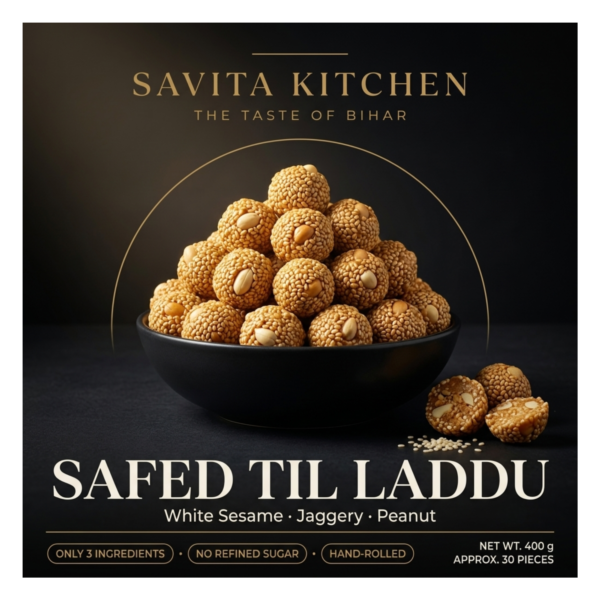
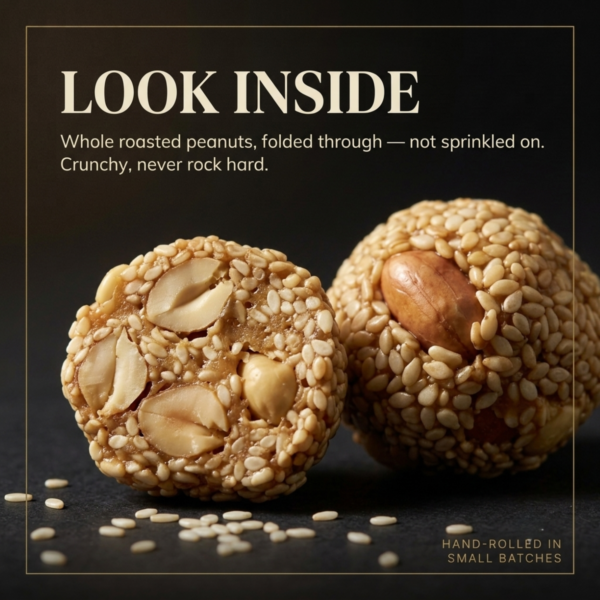
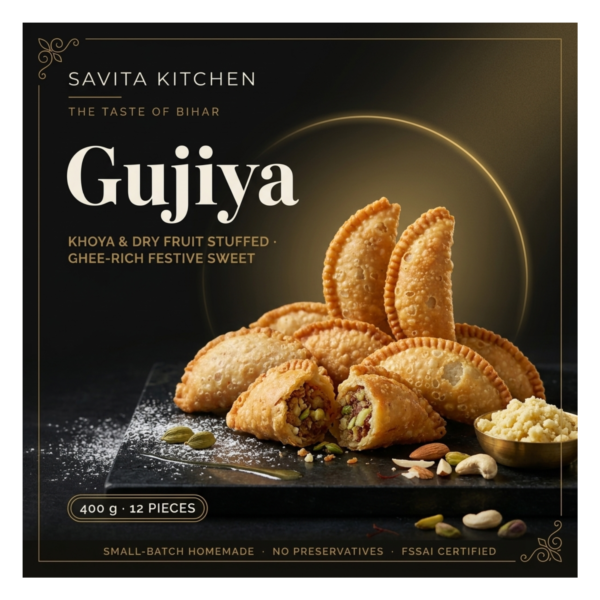
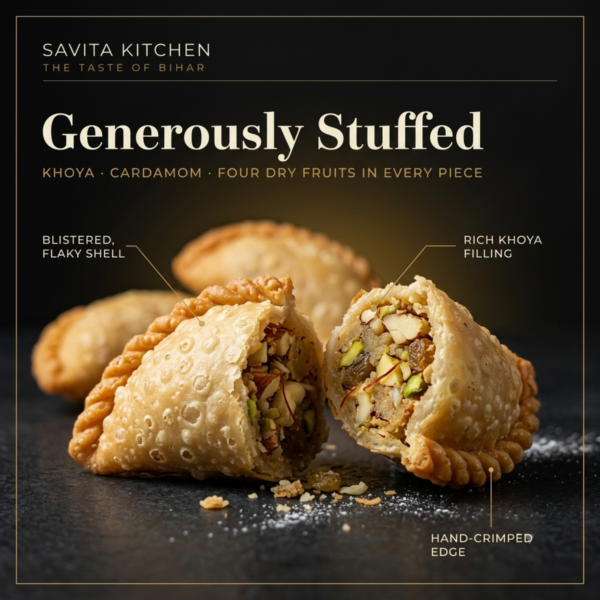
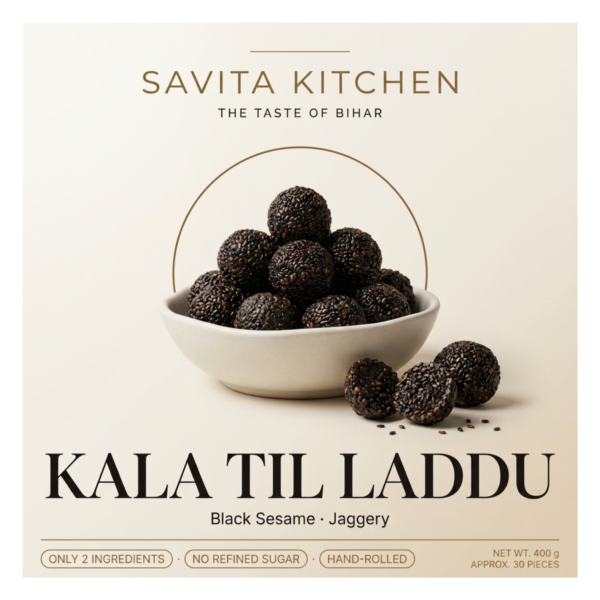
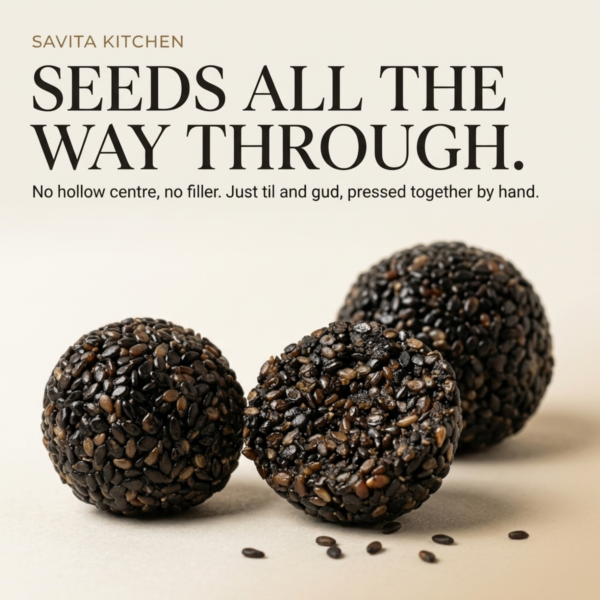
Make it a festive order with Gujiya or Kala Til Laddu, or browse all our Bihari sweets.
Reviews
There are no reviews yet.