Description
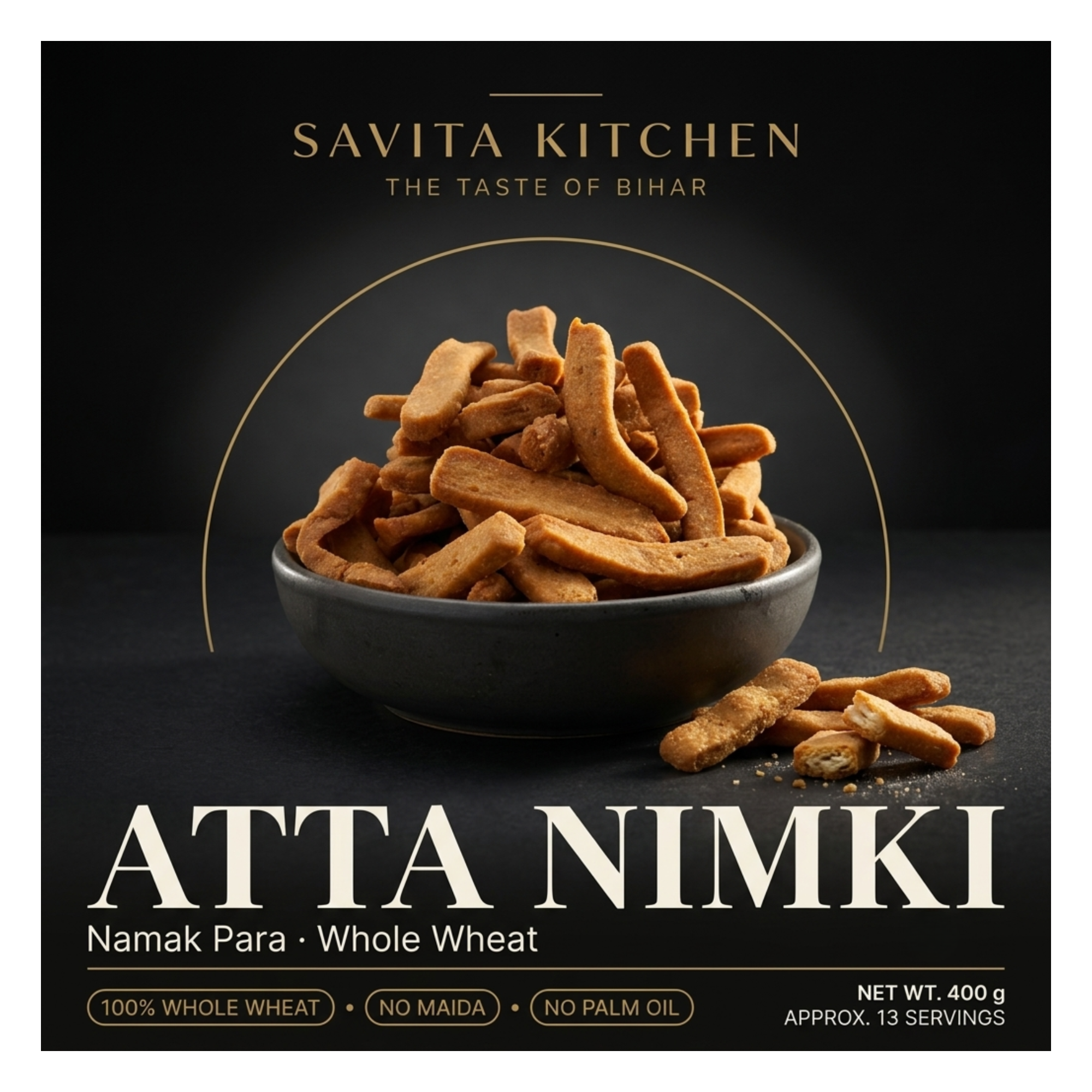
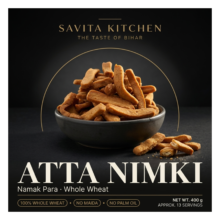
Before maida arrived in Indian kitchens, nimki was made with whatever flour the house already had — and in most houses that was atta. This is that version. Whole wheat, rolled thin, cut into fingers by hand and fried once in sunflower oil until it turns a deep gold.
Ajwain and kalonji go into the dough while it is being kneaded, so the flavour runs through each piece rather than sitting on the surface. Made in small batches in our kitchen in Raipur and sealed into a zip-lock pouch the day it is fried.
( the flour )
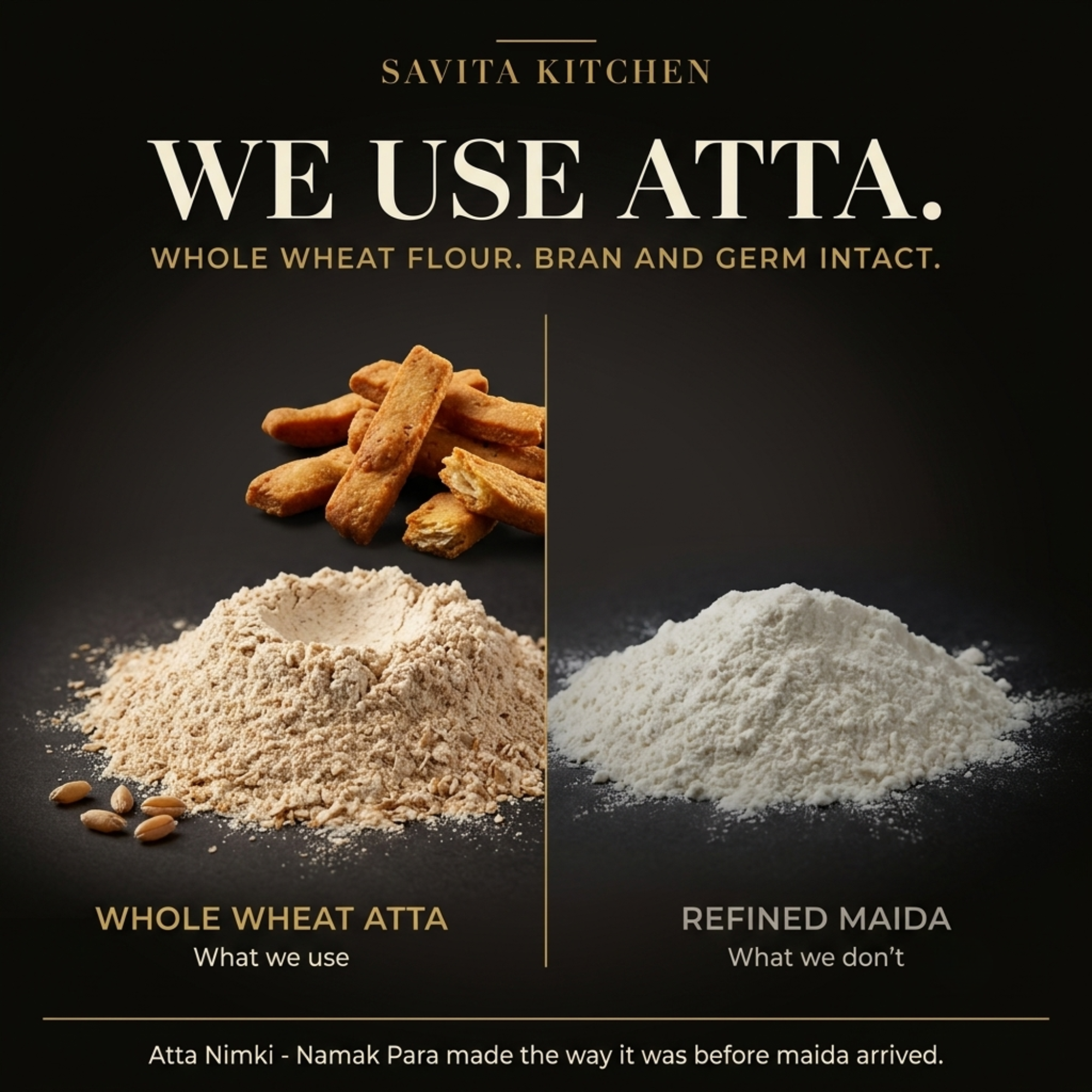
We use atta. Bran and germ intact.
Maida is wheat with the bran and the germ milled out of it. What is left is the starchy endosperm — white, fine, and easy to work with, which is exactly why the snack industry moved to it. Atta keeps the whole grain.
It is harder to work with. Atta dough is less forgiving, it does not roll as thin, and it browns faster in the oil, so the frying window is narrower. It also costs more. We make it anyway, because a large number of the people who write to us are specifically trying to keep maida out of the house.
The taste is different too, not just the flour label. Atta nimki is nuttier and earthier, with a firmer bite than the maida version and a hard, clean snap when you break it.
( what goes in )
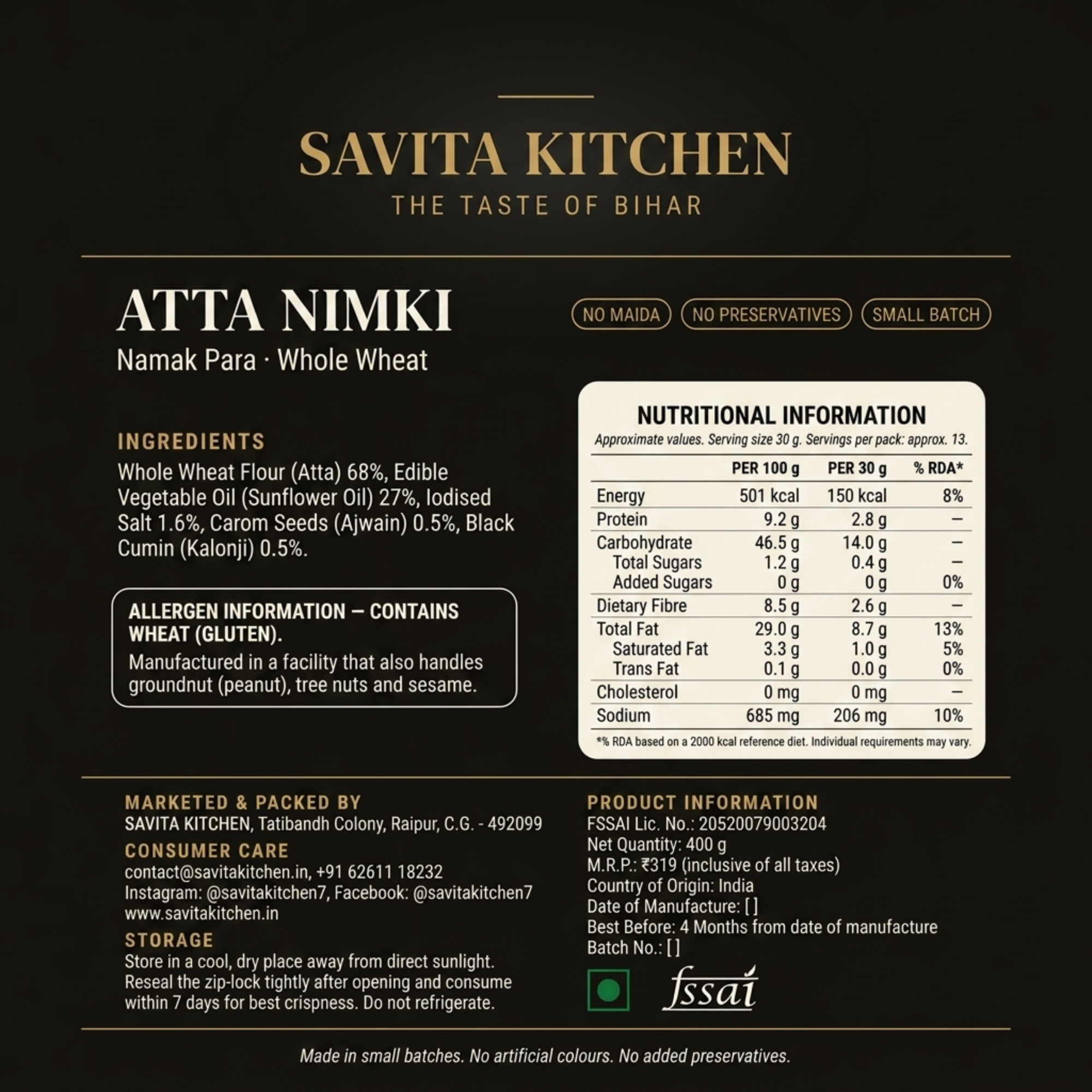
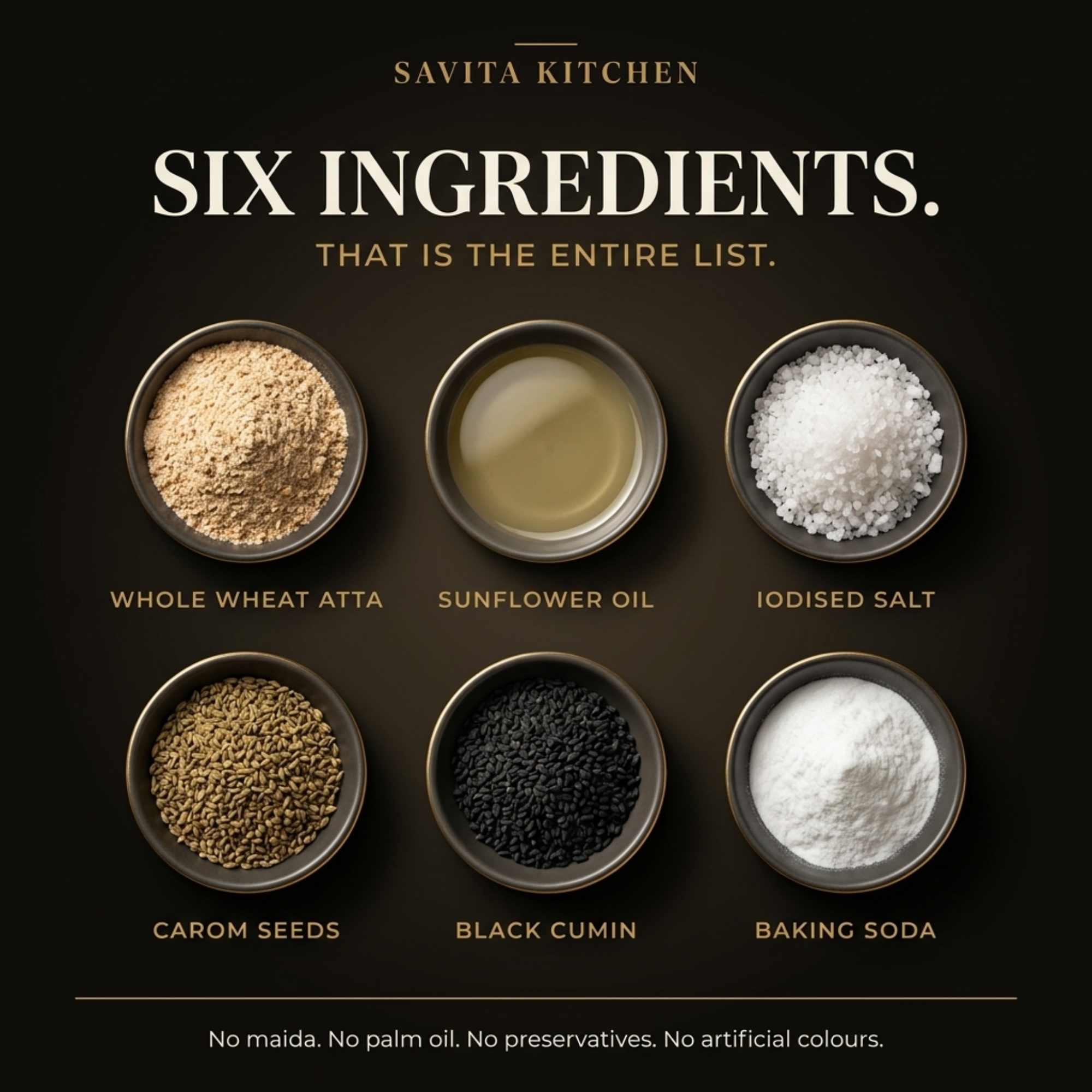
A short list, printed in full
| Whole wheat flour (atta) | 68% |
| Sunflower oil | 27% |
| Iodised salt | 1.6% |
| Carom seeds (ajwain) | 0.5% |
| Black cumin (kalonji) | 0.5% |
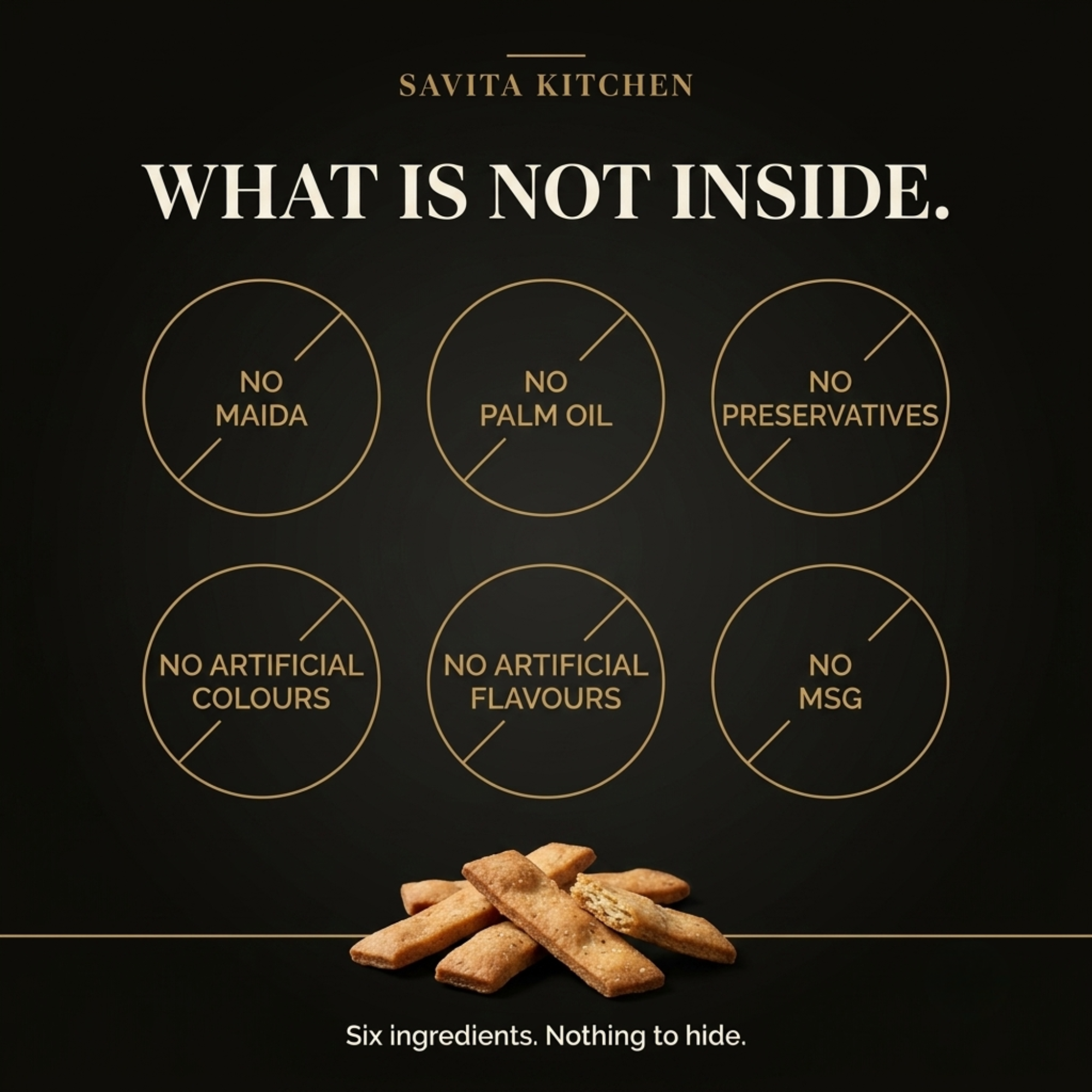
No maida. No palm oil. No preservatives. No artificial colours or flavours. No MSG.
Allergen information — contains wheat (gluten). Made in a kitchen that also handles groundnut (peanut), tree nuts, sesame, milk and soy.
( the bite )
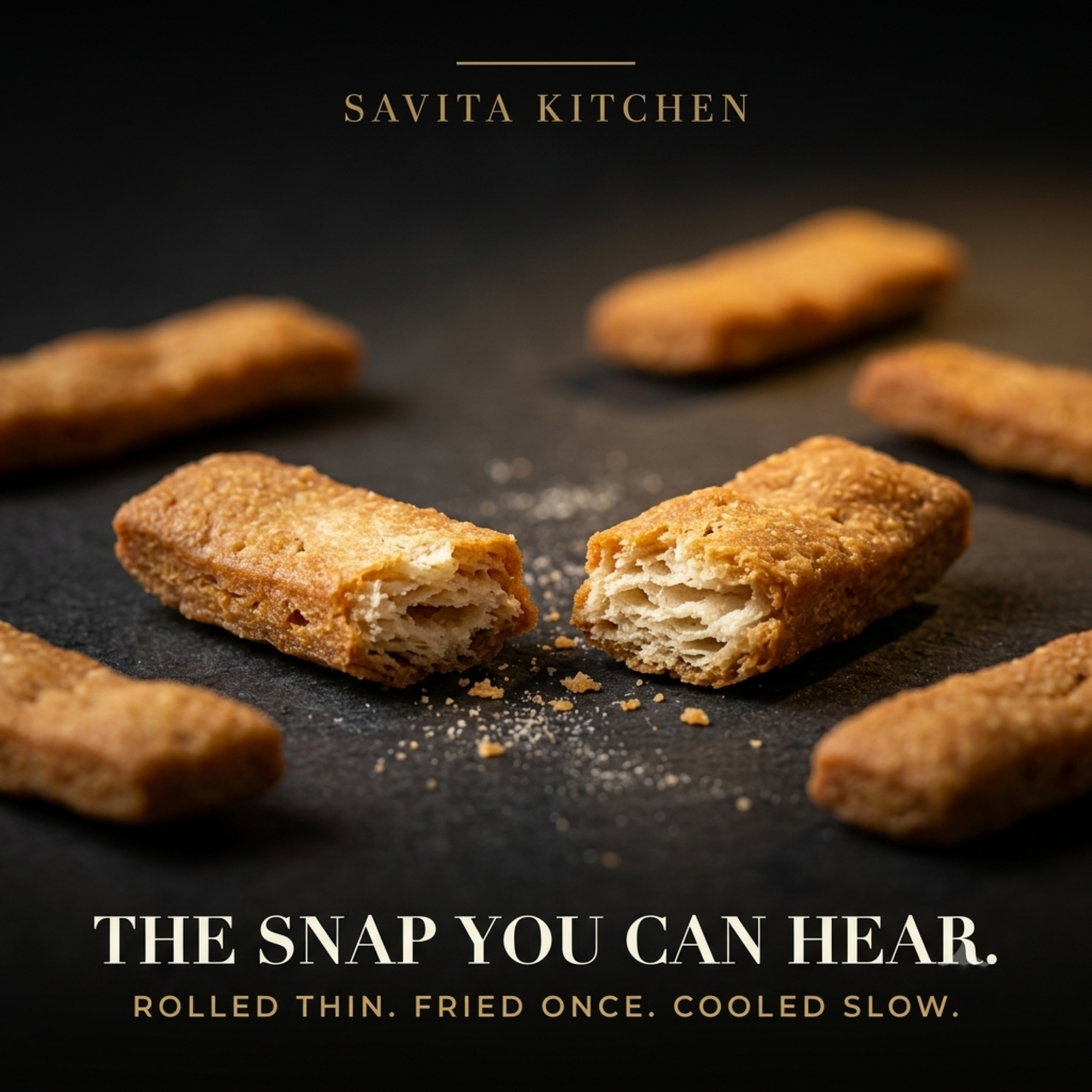
The snap you can hear
Rolled thin. Fried once, never twice. Cooled slowly on a rack rather than piled hot into a bag, which is where most namkeen loses its texture before it ever reaches a shelf.
Break one open and you will see a dense, layered crumb rather than a hollow pocket. Atta does not puff the way maida does, and it is not supposed to. What you get instead is a piece with weight to it and a snap you can hear across the room.
( atta or maida )
Two nimkis, one kitchen
We make nimki both ways. They are genuinely different snacks, and which one you want depends less on which is “better” and more on what you are used to.
| Atta Nimki | Maida Nimki | |
|---|---|---|
| Flour | Whole wheat atta | Refined wheat flour |
| Shape | Hand-cut fingers | Hand-cut diamonds |
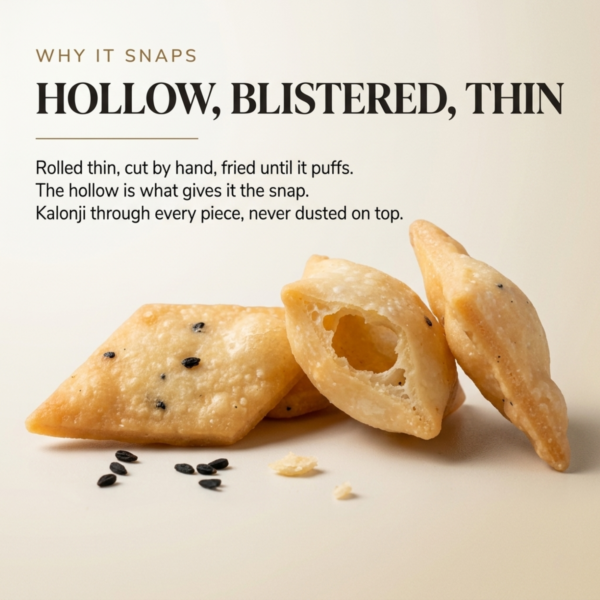
| Texture | Dense, layered, hard snap | Light, hollow, blistered |
| Spices | Ajwain and kalonji | Kalonji |
| Dietary fibre | 8.5 g per 100 g | 1.6 g per 100 g |
| Fried in | Sunflower oil | Sunflower oil |
| Best for | Households keeping maida out | The classic, lighter bite |
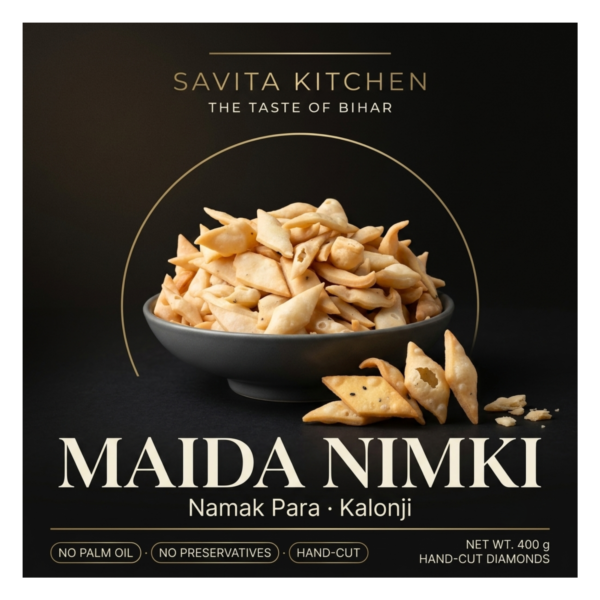
Both are fried and both are salted — the difference between them is in the flour, not in the frying. If you want the version most people grew up on, that is our Maida Nimki.
( how it is made )
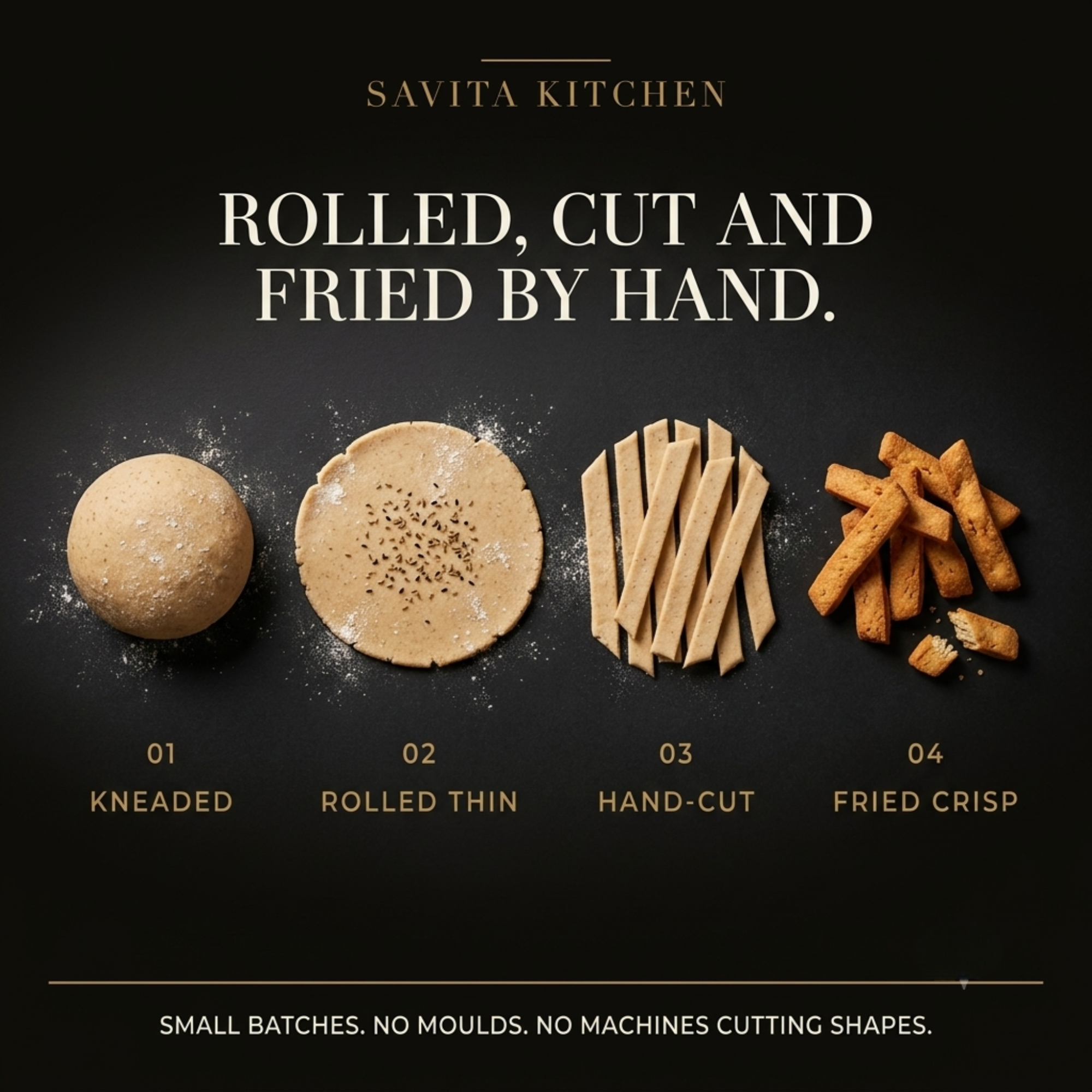
Rolled, cut and fried by hand
Atta, oil, iodised salt, ajwain and kalonji worked into a firm dough and rested.
Rolled out flat. Atta will not go as thin as maida, so this step decides the bite.
Cut into fingers with a knife. No moulds, no machines cutting shapes.
Fried once in sunflower oil, drained, then cooled slowly before it is sealed.
( when to eat it )
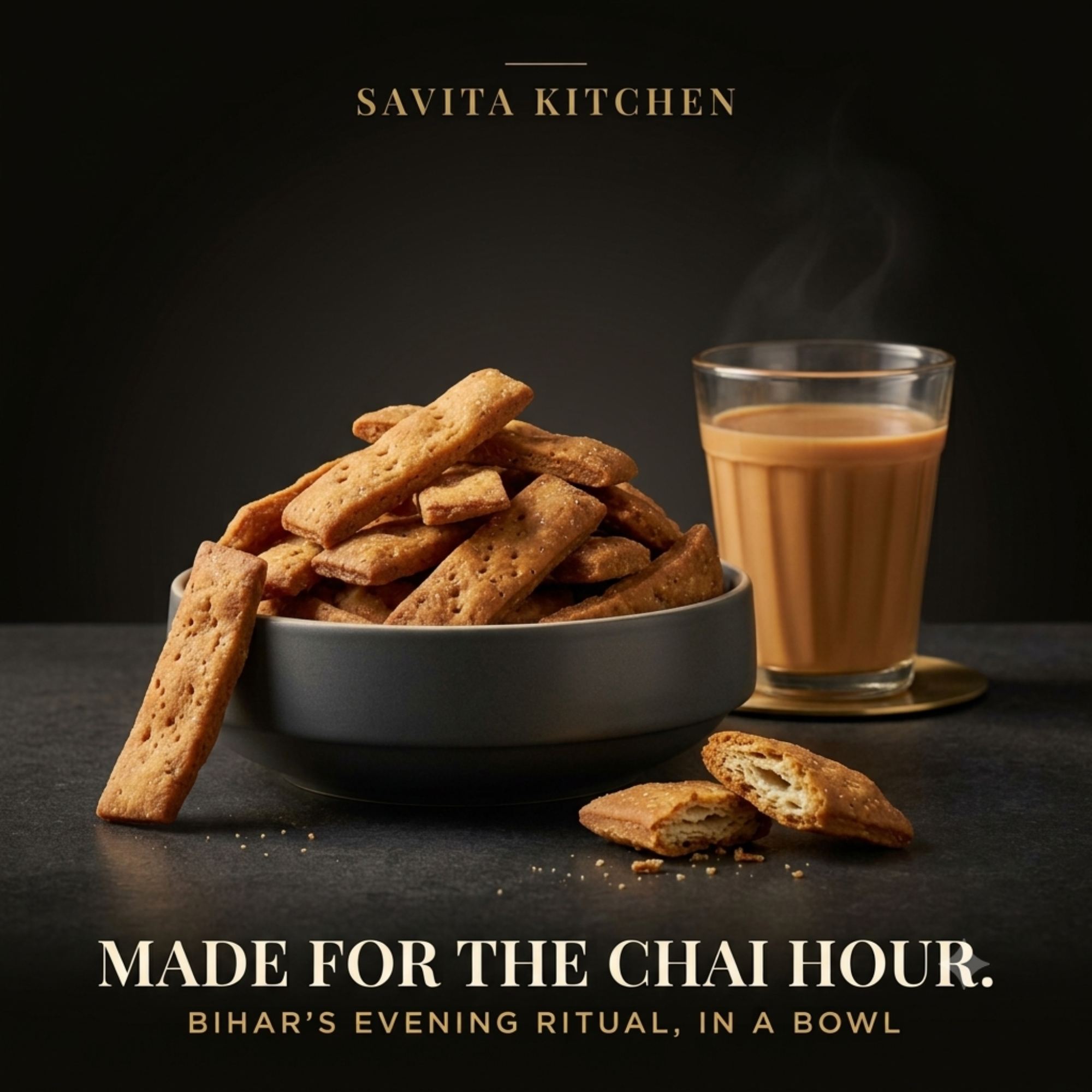
Made for the chai hour
Bihar’s evening ritual, in a bowl. Nimki and chai at five o’clock is not a snack so much as a fixed appointment.
- With evening chai. The firmer bite holds up to dunking, which the maida version does not.
- In the tiffin box. Sturdy enough to survive a bag without turning to crumbs.
- When guests come. Put a bowl out and let people help themselves.
- For the house that avoids maida. The reason most people order this one instead of the classic.
- Alongside something sweet. A bowl of nimki and a couple of til laddu is how most of our customers order.
( choose your size )
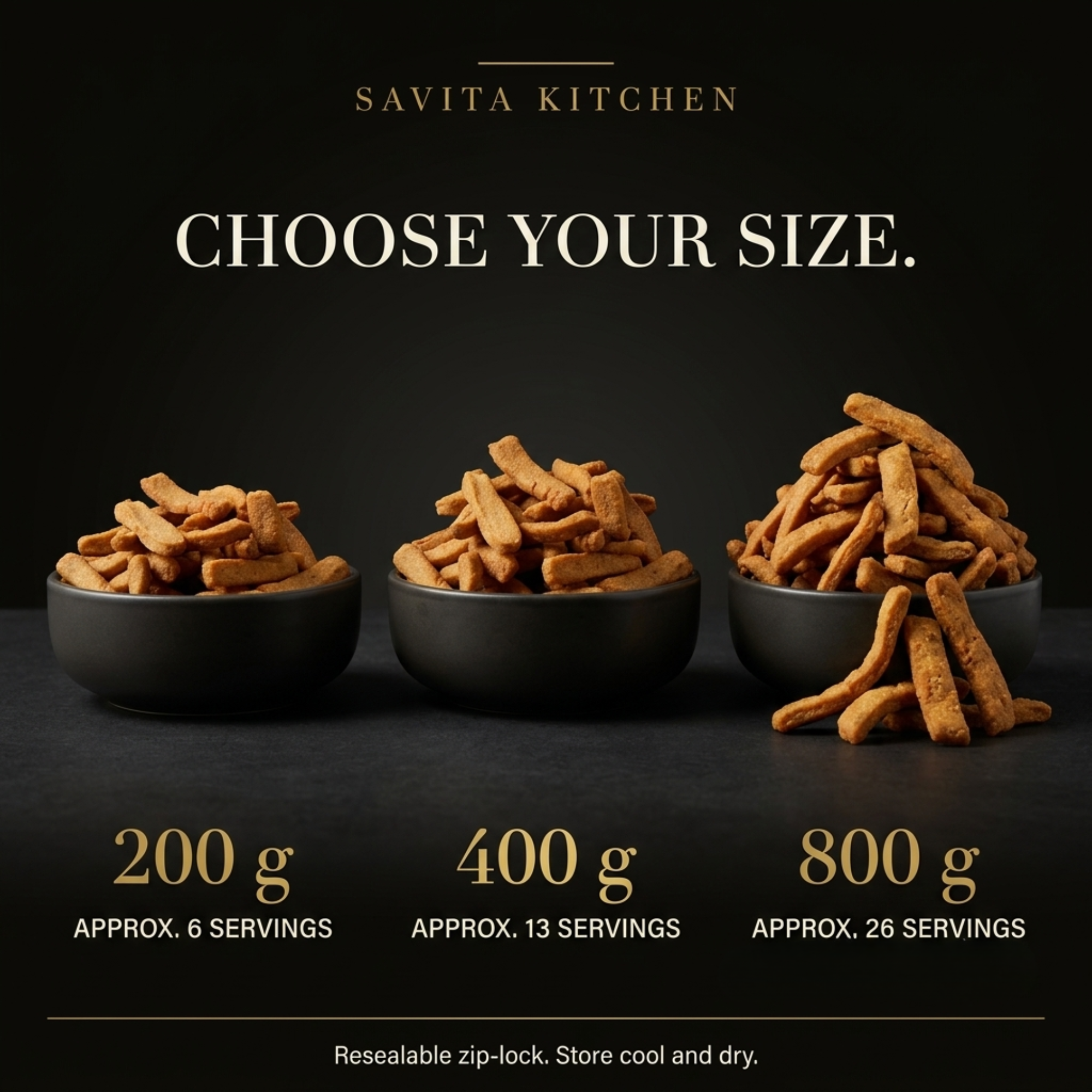
Three packs, all with a zip-lock
Try it first, especially if you have only ever had the maida version.
The household size. What most families go through in a fortnight of chai.
Best value — roughly 22% cheaper per 100 g than the small pack. For big houses and offices.
( nutrition )
What is in a 30 g serving
| Per 100 g | Per 30 g | |
|---|---|---|
| Energy | 501 kcal | 150 kcal |
| Protein | 9.2 g | 2.8 g |
| Carbohydrate | 46.5 g | 14.0 g |
| Total sugars | 1.2 g | 0.4 g |
| Added sugars | 0 g | 0 g |
| Dietary fibre | 8.5 g | 2.6 g |
| Total fat | 29.0 g | 8.7 g |
| Saturated fat | 3.3 g | 1.0 g |
| Trans fat | 0.1 g | 0.0 g |
| Cholesterol | 0 mg | 0 mg |
| Sodium | 685 mg | 206 mg |
Approximate values. Using atta instead of maida changes the flour and the fibre; it does not change the fact that this is a fried, salted snack. We would rather print the numbers than dress them up.
( keeping it crisp )
Storage and shelf life
Whole wheat keeps the bran and the germ, and the germ carries oils that stale faster than refined flour does. That is why we say seven days after opening rather than the longer window we give the maida version — and it is why every pack has a zip-lock.
- Press the zip-lock shut properly the moment you have taken some out. An air-tight tin is better still.
- Finish within about 7 days of opening for the best snap.
- Store in a cool, dry place, away from direct sunlight.
- Do not refrigerate. The fridge is damp and it will go soft.
- Best before 4 months from the date of manufacture, printed on every pack.
- Ready to eat. Nothing to heat, fry or prepare.
( the details )
Product information
| Product | Atta Nimki — whole wheat namak para with ajwain and kalonji |
| Ingredients | Whole wheat flour (atta) 68%, edible vegetable oil (sunflower oil) 27%, iodised salt 1.6%, carom seeds (ajwain) 0.5%, black cumin (kalonji) 0.5% |
| Pack sizes | 200 g · 400 g · 800 g, all in resealable zip-lock pouches |
| Allergen information | Contains wheat (gluten). Made in a kitchen that also handles groundnut (peanut), tree nuts, sesame, milk and soy. |
| Fried in | Sunflower oil. Never palm oil. |
| Dietary | Vegetarian (green dot). No maida, no added sugar, no preservatives, no MSG. |
| Shelf life | 4 months from date of manufacture |
| Marketed & packed by | Savita Kitchen, Tatibandh Colony, Raipur, Chhattisgarh 492099 |
| FSSAI licence | 20520079003204 |
| Country of origin | India |
( our story )
Cut by hand, in Raipur
Savita Kitchen started at my mother’s stove. She has been rolling and cutting nimki for thirty years — first for the family, then for neighbours who kept asking, and now for homes across India. The atta version is the older one; the maida came later, when everybody’s did.
Every batch is kneaded, rolled, cut, fried and sealed by us. Orders leave the kitchen within 24 hours, so what reaches you is close to what came out of the pan.
Ships across India · Cash on delivery available · Questions before you order? Message us on WhatsApp or write to contact@savitakitchen.in.
Reviews
There are no reviews yet.