
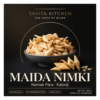
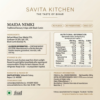
Maida Nimki — Bihar’s Everyday Tea-Time Crisp
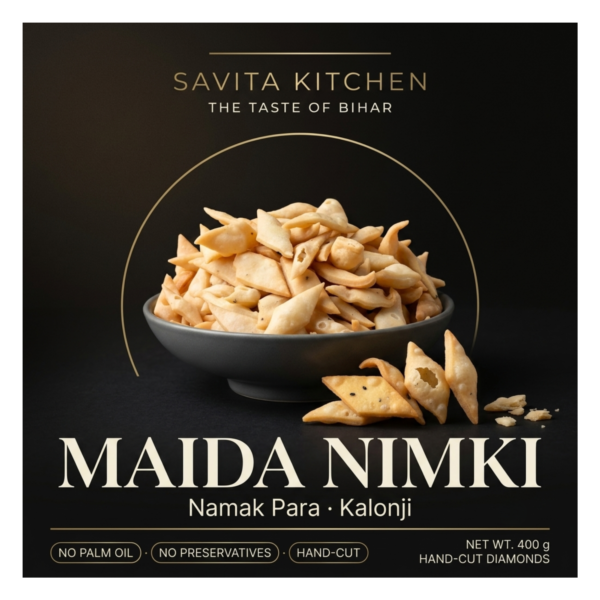
In Bihar, nimki is not something you plan for. It is what appears the moment a guest sits down, the moment the kettle goes on, the moment a train journey begins. Thin diamonds of dough, flecked with kalonji, fried until they shatter between your teeth.
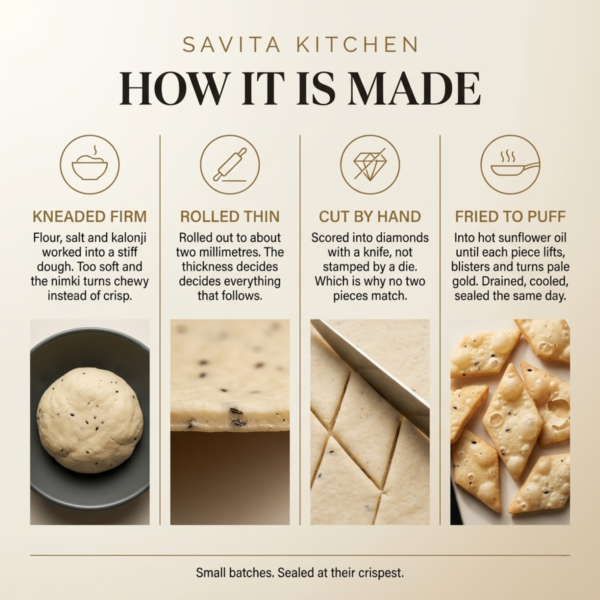
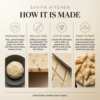
Our Maida Nimki follows the recipe Savita Devi has used for decades in her kitchen. The dough is kneaded stiff, rested, rolled thin, cut into diamonds by hand — never stamped by a die — and fried in fresh sunflower oil in small batches. That is the entire method. There is nothing else in the pack and nothing else in the process.
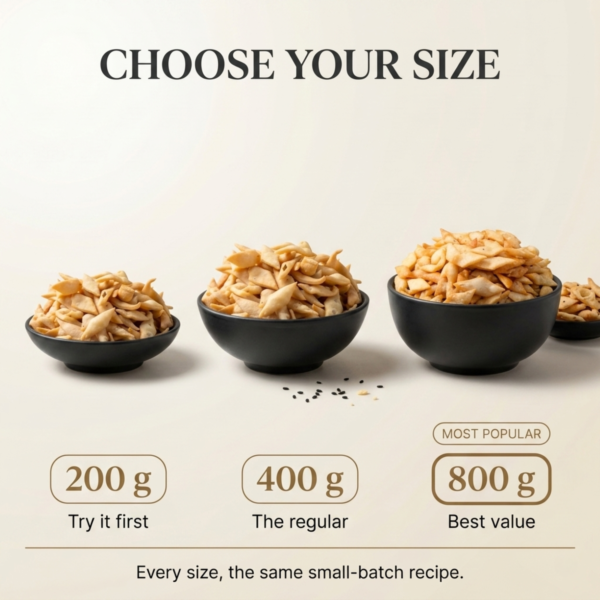
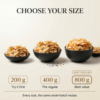
Choose Your Size
Same small-batch recipe in every pack. The only thing that changes is how long it lasts in your house.
| Pack | Servings (30 g) | M.R.P. | Per 100 g | Best for |
|---|---|---|---|---|
| 200 g | approx. 7 | ₹179 | ₹89.50 | Trying it for the first time |
| 400 g | approx. 13 | ₹319 | ₹79.75 | The regular household pack |
| 800 g | approx. 27 | ₹549 | ₹68.63 | Best value, big families, gifting |
The 400 g works out ₹39 cheaper than buying two 200 g packs. The 800 g saves you ₹167 against four of them — roughly a quarter off, for the same nimki.
What Makes This Namak Para Different
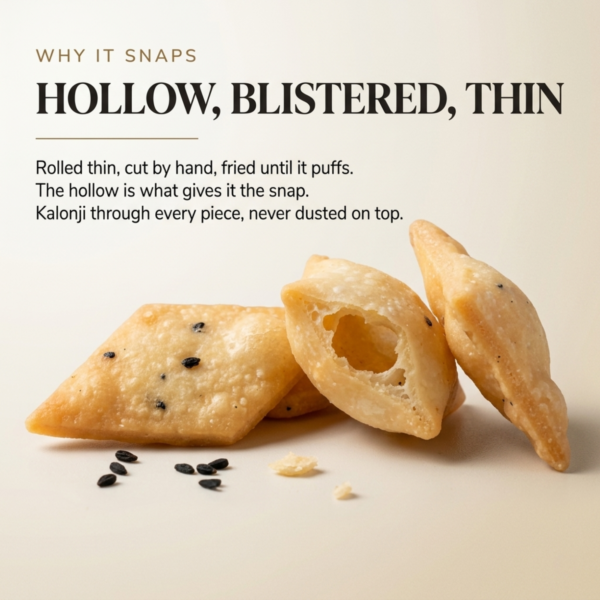
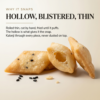
Hollow, blistered, thin
Rolled out to about two millimetres, then fried until each piece lifts and puffs. That hollow centre is the whole secret — it is what makes the nimki snap rather than crunch. Roll it thicker and you get something closer to a biscuit. The thickness decides everything that follows.
Cut by hand, not by machine
Machine-cut nimki is uniform, and uniform is exactly what you do not want. Scoring the sheet with a knife leaves edges of slightly different thickness, so one mouthful gives you both the shatter of a thin corner and the bite of a thicker centre. It is slower. It is why ours tastes like it came out of a home kitchen, because it did.
Fried in sunflower oil, never palm
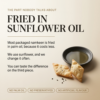
Almost every packaged namkeen on an Indian shelf is fried in palm oil, because palm oil is cheap and stable. We use fresh sunflower oil and change it often. It costs us more per kilo. It also means the nimki tastes of wheat and kalonji instead of tasting of fryer — and you notice it by about the third piece.
Kalonji through the dough, not dusted on top
Black cumin — kalonji — is what separates real Bihari nimki from a plain salted cracker. Those small black seeds pop with a faint bitterness and a warm, oniony note that cuts the richness. We work it into the dough itself, so it does not shake loose and settle at the bottom of the pack.
Sealed the same day it is fried
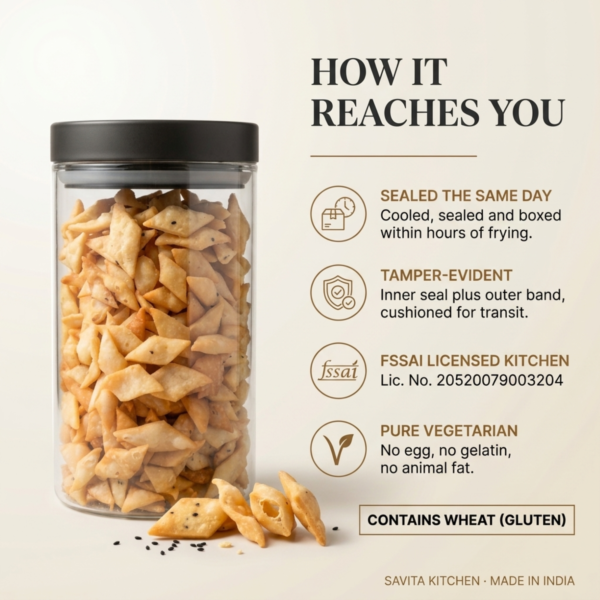
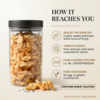
Fried, drained, cooled completely, sealed within hours. Nothing sits in a warehouse for months waiting for an order. This is also why there are no preservatives in the list — we are not trying to fake a shelf life we do not want.
How to Eat Maida Nimki
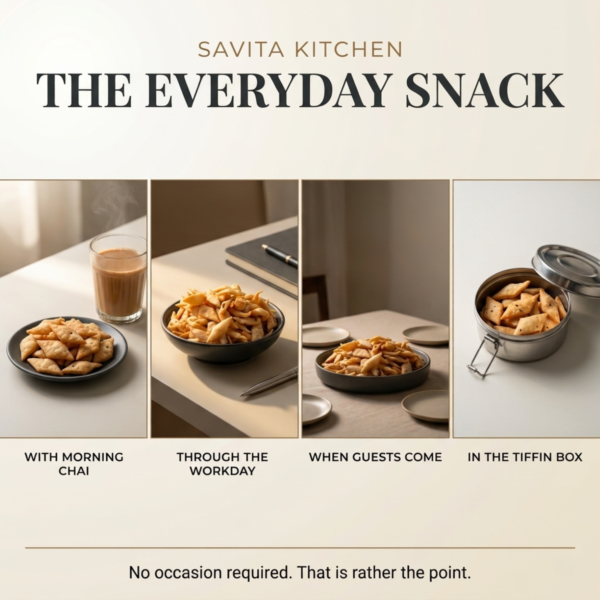
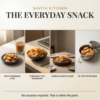
- With morning chai. The classic pairing across Bihar, Jharkhand and Bengal.
- Through the workday. A bowl on the desk that does not need a plate, a spoon or a break.
- When guests come. The thing that goes down before anyone has decided what else to serve.
- In the tiffin box. Nimki travels better than any other snack — no crumbling to dust, no melting, no mess.
- With mango pickle. A spoon of achar oil against the salt is the whole point.
Ingredients
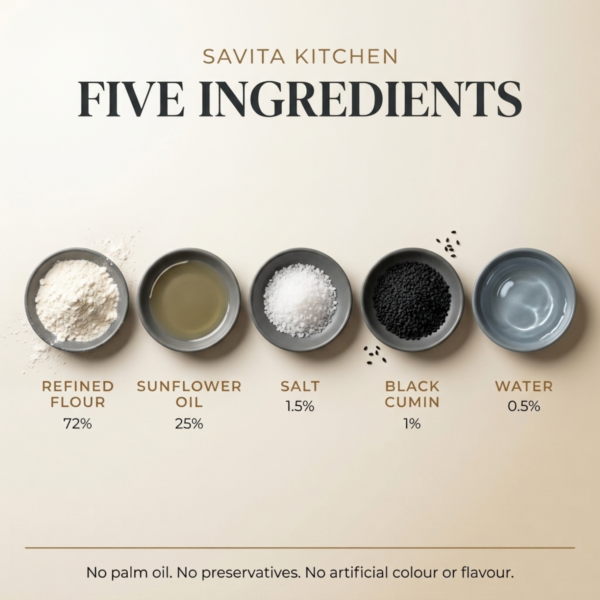
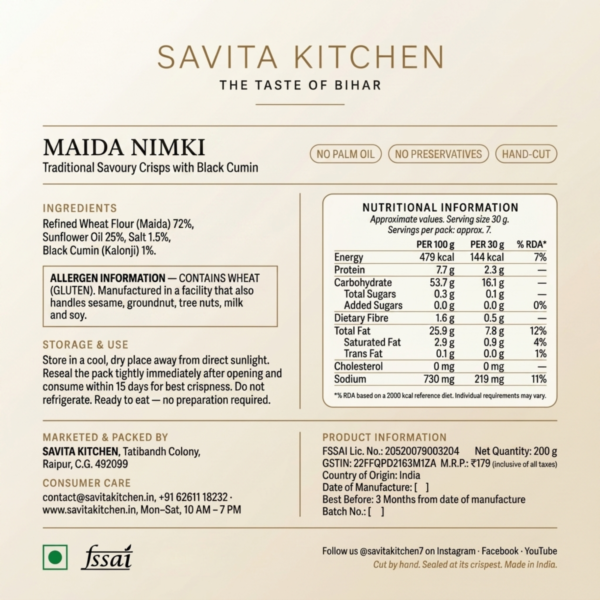
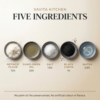
Refined Wheat Flour (Maida) 72%, Sunflower Oil 25%, Salt 1.5%, Black Cumin (Kalonji) 1%.
Allergen information: Contains wheat (gluten). Manufactured in a facility that also handles sesame, groundnut, tree nuts, milk and soy.
No palm oil. No preservatives. No artificial colour or flavour. No egg, no gelatin, no animal fat.
Nutritional Information
Approximate values. Serving size 30 g. Identical across all three pack sizes — only the number of servings changes (approx. 7 in the 200 g, 13 in the 400 g, 27 in the 800 g).
| Nutrient | Per 100 g | Per 30 g | % RDA* |
|---|---|---|---|
| Energy | 479 kcal | 144 kcal | 7% |
| Protein | 7.7 g | 2.3 g | — |
| Carbohydrate | 53.7 g | 16.1 g | — |
| Total Sugars | 0.3 g | 0.1 g | — |
| Added Sugars | 0.0 g | 0.0 g | 0% |
| Dietary Fibre | 1.6 g | 0.5 g | — |
| Total Fat | 25.9 g | 7.8 g | 12% |
| Saturated Fat | 2.9 g | 0.9 g | 4% |
| Trans Fat | 0.1 g | 0.0 g | 1% |
| Cholesterol | 0 mg | 0 mg | — |
| Sodium | 730 mg | 219 mg | 11% |
*% RDA based on a 2,000 kcal reference diet. Individual requirements may vary.
Storage & Shelf Life
Store in a cool, dry place away from direct sunlight. Reseal the pack tightly immediately after opening and finish within 15 days for best crispness. Do not refrigerate — moisture is nimki’s only real enemy. Ready to eat; no preparation required.
Best before: 3 months from the date of manufacture printed on the pack.
Product Details
| Available Sizes | 200 g · 400 g · 800 g |
|---|---|
| M.R.P. (inclusive of all taxes) | ₹179 · ₹319 · ₹549 |
| Also Known As | Namak Para, Namakpara, Nimkee, Salt Para |
| Cuisine | Bihari · North Indian |
| Diet | Pure Vegetarian — no egg, no gelatin, no animal fat |
| Spice Level | Mild — not spicy |
| Form | Ready to eat |
| Country of Origin | India |
| Marketed & Packed By | Savita Kitchen, Tatibandh Colony, Raipur, Chhattisgarh 492099 |
| FSSAI Licence No. | 20520079003204 |
| Consumer Care | contact@savitakitchen.in · +91 62611 18232 · Mon–Sat, 10 AM – 7 PM |
Frequently Asked Questions
Which size should I buy?
If you have not tried our nimki before, take the 200 g. If you know you like it, the 400 g is the sensible household pack and works out ₹39 cheaper than two 200 g packs. The 800 g is the best value at ₹68.63 per 100 g — worth it for a large family, a festival, or sending to someone who grew up on this.
How many servings are in each pack?
At a 30 g serving: about 7 servings in the 200 g pack, about 13 in the 400 g, and about 27 in the 800 g.
Is nimki the same as namak para?
Yes — same snack, different name. It is called nimki across Bihar, Jharkhand and Bengal, and namak para or namakpara across most of North India. Mathri is a cousin, but thicker, rounder and usually made with ajwain rather than kalonji.
What is the difference between Maida Nimki and Atta Nimki?
Maida Nimki is made with refined wheat flour — lighter, flakier, and it shatters when you bite. Atta Nimki uses whole wheat flour, which makes it denser, nuttier and a little more filling. Neither is better; they are different textures. Most families keep both.
Is it spicy?
No. Maida Nimki is a salted savoury, not a chilli snack. The only seasoning is salt and kalonji. Safe for children and for anyone who avoids heat.
How long does it stay crisp after opening?
About 15 days if you reseal the pack tightly each time. Because there are no preservatives, an open pack left uncovered in humid weather will soften within a few days. Transfer to an airtight jar if you live somewhere very humid.
Do you use palm oil?
Never. We fry exclusively in fresh sunflower oil and change the oil frequently.
Is Maida Nimki gluten-free?
No. It is made from refined wheat flour and contains gluten. Not suitable for anyone with coeliac disease or a wheat allergy.
Where do you ship?
All across India. Orders are packed and dispatched within 24–48 working hours from our kitchen in Raipur, Chhattisgarh.
Reviews
There are no reviews yet.